What Utility Can You Use to Edit the Registry
Everywhere y'all turn you discover someone telling anybody to stay clear of the Registry. While I agree with this to an extent, I have come to realize that a lot of what we do involves the Registry whether we know information technology or not. If you're looking to customize your Windows Operating System at some bespeak, you lot are going to have to deal with the Registry. If you lot are a novice, yous may want to read this post on Windows Registry Basics – simply do remember that this postal service is meant for avant-garde users, and one must ever support the Registry earlier touching it.
Windows Registry Editor
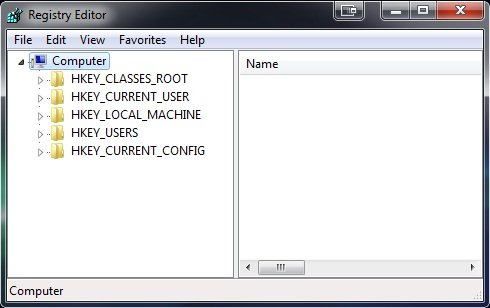
If you are uncomfortable messing around the Registry, and so I would never say that you should mess with it. If your a user who loves to customize your Windows Operating Arrangement and so the truth is, whether you do information technology manually or utilise some freeware program to customize with – it all deals with the Registry and is unavoidable.
This list of tips to piece of work with the Registry, I hope, will ease your discomfort some and make it a picayune fleck easier to manage. Only remember, if you are unsure, its all-time to stay away from information technology.
Access or open the Windows Registry
The Windows Registry files are located in the system32/config folder, but you lot, of course, demand to use the congenital-in registry editing utility called Regedit to handle Registry which you can access by the following locations:
- Hit the Commencement Button > Run > blazon Regedit and hit enter.
- Open the Chore Director > File > New Task > type Regedit and hitting enter.
- In a Control Prompt type Regedit and striking enter.
TIP: Users of Windows 10 tin use the Address Bar to jump straight to whatever registry key or change the Font.
Create a desktop shortcut to open Windows Registry
If y'all prefer you can add a shortcut to the desktop to Regedit past doing the following:
- Right-click a blank area on the desktop, press New so press Shortcut. For Location, type Regedit click adjacent and choose a name for your Shortcut and finally click Cease.
Files with .reg extension
Downloaded a file with the extension .reg just you are unsure of what it may do? Right-click the file and select Edit or Open in Notepad and you will be able to see the location of the Registry fundamental information technology volition dispense.
For instance, the following .reg file when opened in Notepad volition wait like the following with the location in bold and values underneath.
[HKEY_CURRENT_USER\Software\Microsoft\InternetExplorer\Chief\WindowsSearch] "Version"="6.ane.7600.16385" "User Favorites Path"="file:///C:\\Users\\Lee\\Favorites\\" "UpgradeTime"=hex:iron,27,f3,41,02,91,cc,01 "ConfiguredScopes"=dword:00000005 "LastCrawl"=hex:3e,26,a3,a1,cd,ninety,cc,01 "Cleared"=dword:00000001 "Cleared_TIMESTAMP"=hex:23,9d,94,eighty,24,48,cc,01
If you are unsure of what the .reg file is going to do, y'all tin always re-create the location and search online for it.
Read: How to edit Registry for another User in Windows.
Backup earlier touching the Windows Registry
If yous are working in Regedit, there are a number of things you can do hands, to avoid messing up with the Registry.
- Before making changes to the Registry, it is ever recommended to quickly create a Organisation Restore Indicate starting time, as this will enable y'all to return to the previous state before you did changes.
- If you would similar to create a backup of a Registry key or Export the key for sharing with someone else, Right-Click the primal and select Export, choose a name and add together .reg as the format. You can also support the Registry using freeware Regback or ERUNTgui.
Change, Add together, Rename keys in Windows Registry
- If you lot want to alter settings to a Registry fundamental, you tin can practice then easily by Double-Clicking the value you wish to change and add the changes yous wish.
- Renaming Registry keys: You need but Right-Click the cardinal or value and select rename.
- To Add a key Correct-Click the key you lot wish to add as a subkey and select New Primal, the same with values.
Read: Registry Editor not opening, crashing or stopped working.
Take ownership of Registry keys
If you find yourself trying to manipulate a Registry cardinal and get an mistake that yous do not have permission to practice, Right-Click the Registry fundamental and select Permissions. 9 out of 10 times when yous exercise this you will need to Accept Ownership of the Registry key offset before giving yourself elevated permissions. To Take Buying, while you lot are in the Registry cardinal properties window, click Advanced\Owner and if your username is not listed select Other Users or Groups and enter your username in the text box. Adjacent click Bank check Names to make sure yous have entered the correct username. Click OK and then yous can alter permissions. Learn more than nearly how to take total ownership of registry keys.
One thing to annotation: If y'all plan on restoring ownership and permissions, take note first of the original possessor and permissions. The post-obit is the default owners list to utilize when selecting an owner in Other Users or Groups:
- Trusted Installer: Blazon in NT SERVICE\TrustedInstaller, click Check Names then click OK.
- System: Type in System, click Check Names then click OK.
- Administrators: Type in Administrators, click Check Names then click OK.
- Your Username: Tye in Your Username, click Check Names then click OK.
- Users: Type in Users, click Check Names then click OK.
Read: When do changes to the Registry get saved?
Add Registry keys to Favorites
Ane characteristic I similar with Regedit is Favorites. As I tend to piece of work a lot inside the same areas in the Registry, adding the keys to Favorites helps to get to these keys rapidly.
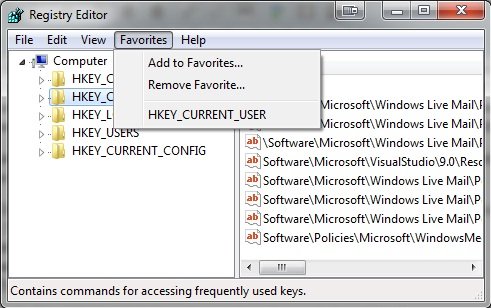
To add a Registry key to Favorites, simply select a cardinal to go to the top carte du jour and select Favorites\Add to Favorites.
Once washed you volition see an entry under Favorites that you demand only click when you wish to get to that Registry key.
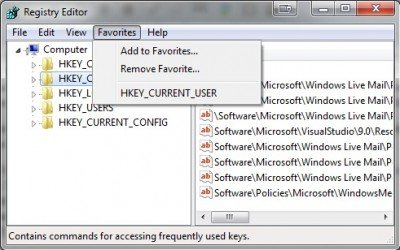
If you know the Registry cardinal y'all are looking for and do not wish to click through Regedit, select Edit > Find and type the location to speedily navigate to the Registry central.
Read: How to create a Registry Fundamental in Windows.
Using Command Prompt to manipulate the Registry
If you are more comfortable working in a Control Prompt, the post-obit commands tin can be used to handle the Registry:
- Reg add : Adds a new subkey or entry to the Registry.
- Reg compare : Compares specified registry subkeys or entries.
- Reg copy : Copies a subkey to another subkey.
- Reg delete : Deletes a subkey or entries from the Registry.
- Reg export : Creates a re-create of specified subkeys, entries, and values into a file in REG (text) format.
- Reg import : Merges a REG file containing exported Registry subkeys, entries, and values into the Registry.
- Reg load : Writes saved subkeys and entries in hive format dorsum to a different subkey.
- Reg query : Displays the information in a subkey or a value.
- Reg restore : Writes saved subkeys and entries in hive format dorsum to the Registry.
- Reg save : Saves a copy of specified subkeys, entries, and values of the Registry in hive (binary) format.
- Reg unload : Removes a section of the Registry that was loaded using reg load.
Example: Reg query HKLM\Software will list all the subkeys
In a Command Prompt if you type in Reg /? Information technology will listing the bachelor commands.
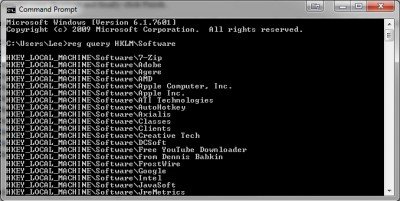
At that place are several other born Control Line tools in Windows for more than advanced users as well such as Regini, but I'll leave those to another mail and go along this for basic use. Past the manner, if yous take wondered where the Windows Registry files are located on the disk, go here to find out!
Read:
- How to open multiple instances of the Registry in Windows
- How to Compare or Merge Registry files
- How to monitor changes to the Registry
- How to directly jump to any Registry key
- How to search Windows Registry Keys, Values and Settings.
Tools to make handling Registry keys like shooting fish in a barrel, for users, without a lot of noesis:
-
Our own RegOwnit which can prepare Buying and Permissions on Registry keys without opening Regedit.
-
SetACL : A Command-Line tool that makes it easier to alter Permissions and Ownership for Registry keys. On the more advanced side merely once you acquire the commands, it's pretty piece of cake to apply.
TIP: See how you can edit Windows Registry without using regedit.exe – but instead by using Reg.exe in Windows 10
Source: https://www.thewindowsclub.com/tips-work-windows-registry-bit-easily-safely
0 Response to "What Utility Can You Use to Edit the Registry"
Post a Comment